Pink noise. Brown noise. White noise. Nature soundscapes. Every track cites peer-reviewed research with a DOI.
No pseudoscience. No medical claims. Just sound, calibrated against the literature.
Free to listen. Long-form tracks for sleep, focus, and calm.
23
Papers cited
34
Tracks live
3
Pillars
−14LUFS
Mastered to spec
Three pillars · 34 tracks, growing
Built around how the brain actually rests, focuses, and recovers.
Each pillar maps to a documented psychoacoustic mechanism, with track durations matching
real use cases — naps, pomodoros, REM cycles, overnight sleep.
Pillar 1 · 3 papers · 19 tracks
Sleep & Rest
Slow-wave enhancement, audited.
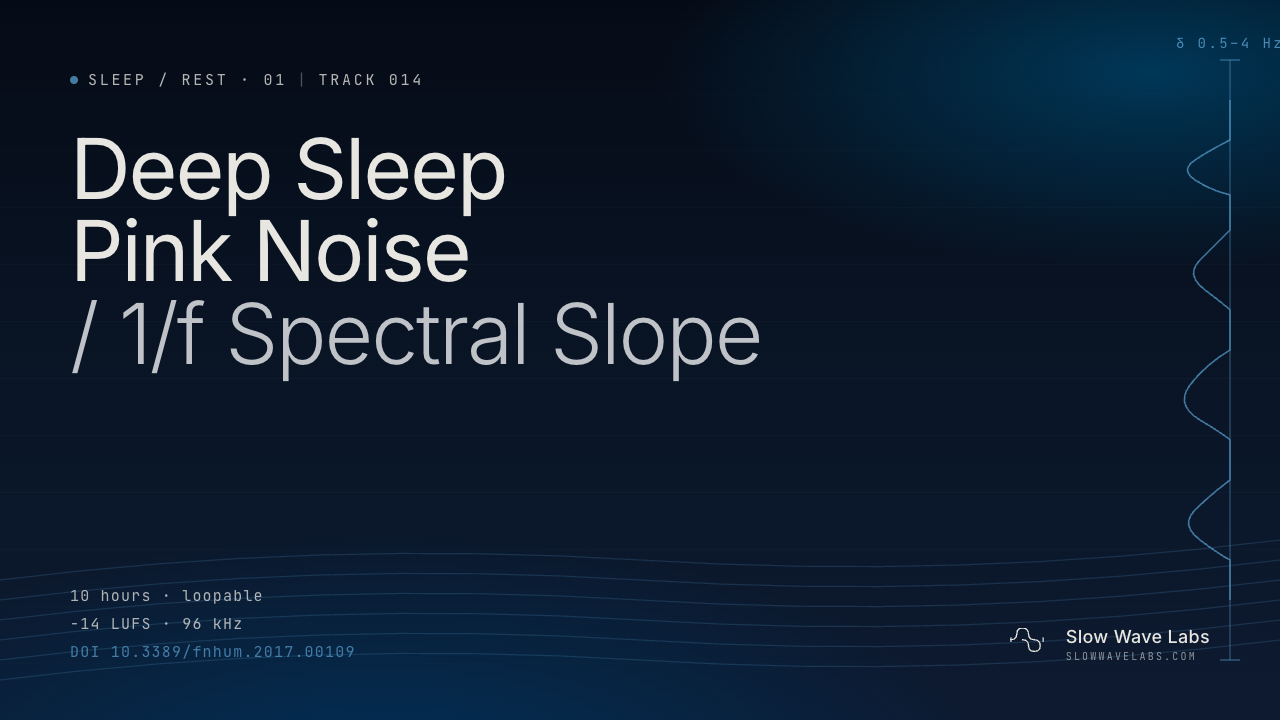
Pink noise tuned to a 1/f spectral slope — the spectral family studied for deep sleep. (The slow-wave benefits came from pulses synchronized to brain activity in the lab, not continuous tracks, so we frame these as masking, not a cure.) Plus rain ambient and seamless overnight loops on a fully black screen — no light to disturb you through the night.
Mechanisms
Pink noise · White noise · Rain & nature
Durations
20 min nap · 45 min wind-down · 8–12 h overnight
Pillar 2 · 9 papers · 8 tracks
Focus & Work
Stochastic resonance for deep work.
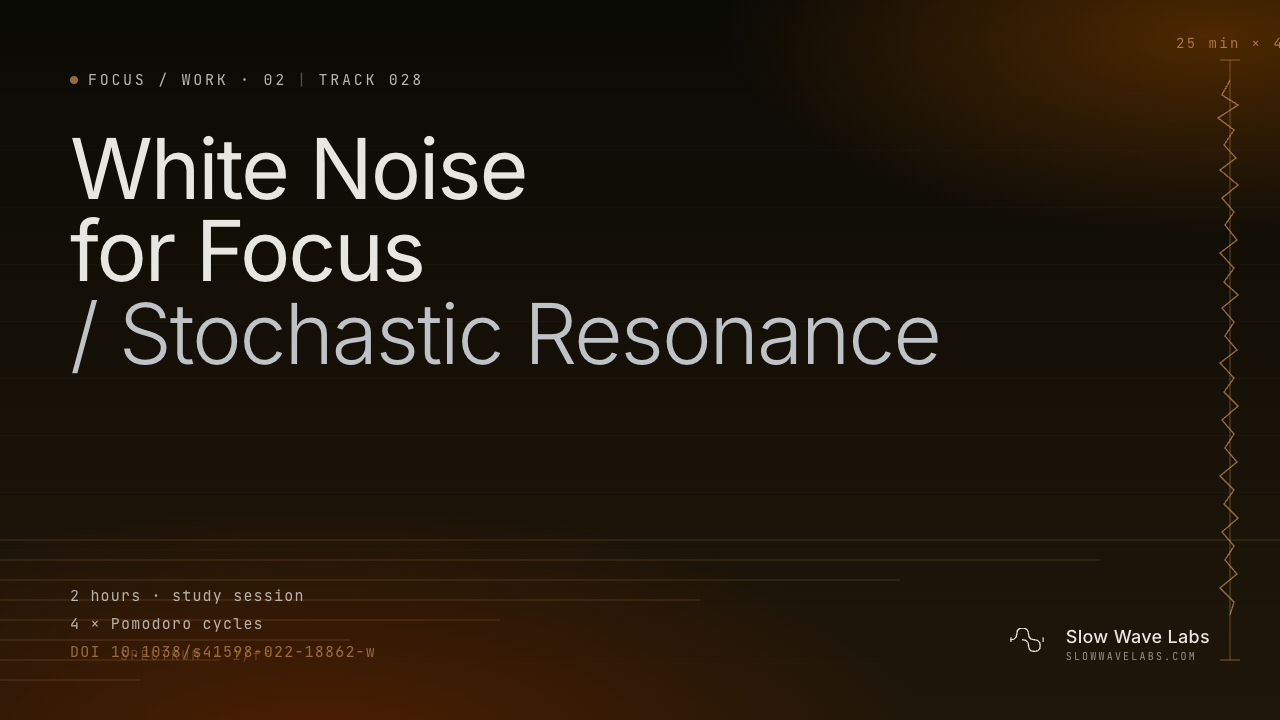
White and brown noise to mask distraction during deep work, studying, and concentration — white noise is the better-researched of the two for attention (the focus studies we cite used white noise). Brown is the deeper, lower-fatigue option. Plus forest ambience for longer study sessions, calibrated against peer-reviewed cognitive-performance studies.
Mechanisms
White noise · Brown noise · Pink noise
Durations
25 min pomodoro · 45 min focus · 90 min deep work
Pillar 3 · 11 papers · 7 tracks
Calm & Regulation
Parasympathetic activation, measured.
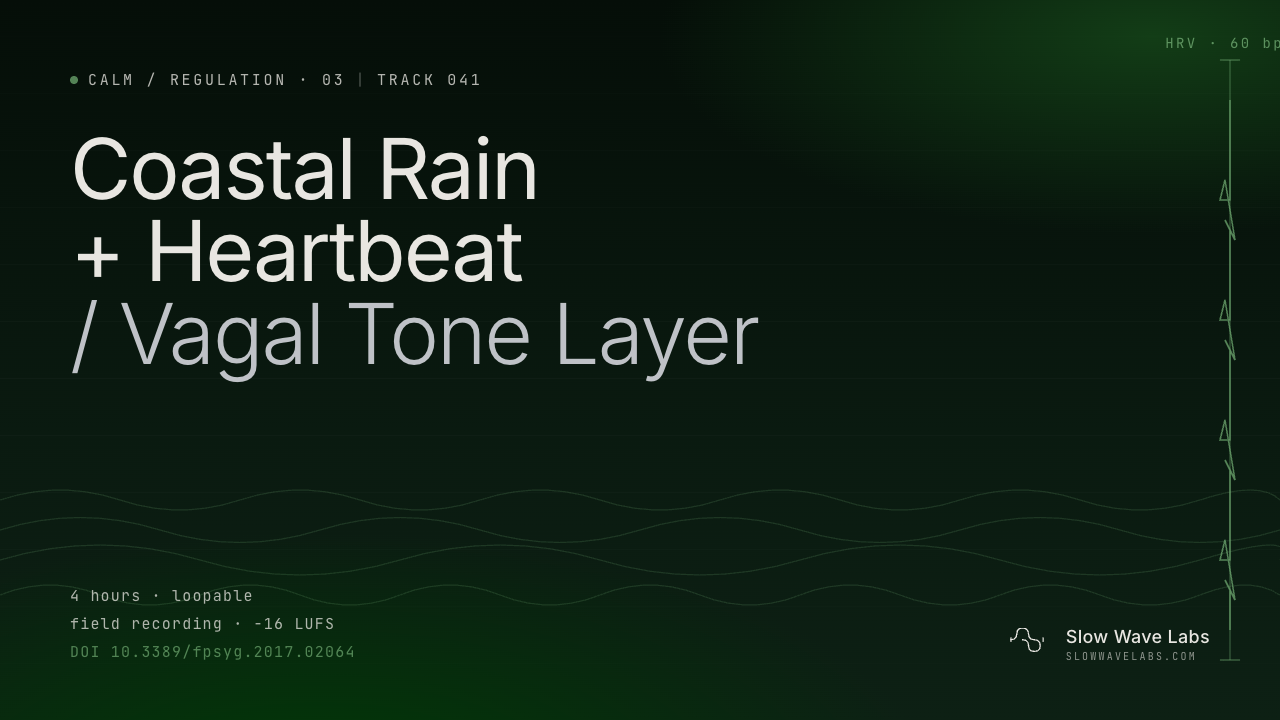
Nature soundscapes shown to accelerate stress recovery (skin conductance, HRV) — ocean, river, distant thunderstorm, and forest-night loops. Long, immersive, and honest about the limits of the evidence.
Mechanisms
Ocean · River · Thunderstorm
Durations
90 min immersion · 3 h flow · 8 h night sounds
Find your moment
What do you need right now?
Pick a moment — each one points to tracks or the research behind it. We don’t offer a
mood the evidence can’t back: ambient sound can calm you, help you focus, or lift a low
mood, but no sound truly “energizes” you, so we don’t pretend otherwise.
"Every other ambient channel sells you mysticism wrapped in calming visuals.
I wanted one that respected your time and your intelligence — and that I'd
actually trust to play for my own kid."
Rafael Farias·Founder · ERP engineer · Insomniac convert
A growing catalog across sleep, focus, and calm — from 20-minute pomodoros to
12-hour overnight loops. Procedural pink, brown, and white noise plus nature
soundscapes, each mastered to −14 LUFS and tied to peer-reviewed research.
Partly, and we are careful here. Pink-noise pulses synchronized to slow brain waves enhanced deep sleep and memory in a lab study (Papalambros et al. 2017) — but a continuous looped track does not reproduce that precise timing; it works as steady, low-fatigue masking. A 2026 study even found continuous masking noise can reduce REM in already-quiet rooms. So: a gentle aid, not a sleeping pill — and we cite the papers so you can judge for yourself.
Is brown noise better than white noise for focus and studying?
It depends on you. Brown noise (1/f² slope) is deeper and less harsh, which many people prefer for deep work and studying. The benefit of background noise on attention is real but asymmetric: it helps people with ADHD-type inattention (Söderlund 2010, Nigg 2024) and can slightly hurt neurotypical performance outside the optimal volume (~45 dB, Awada 2022). Try both; keep it quiet.
What is the best sound for deep work and concentration?
For most people: brown noise or low-volume café/rain ambience kept under ~50 dB, looped for a full pomodoro or 90-minute deep-work block. The mechanism is masking of distraction, not "boosting" the brain. We calibrate every focus track against the cognitive-performance literature instead of marketing claims.
Do rain sounds and nature sounds help with anxiety and stress?
Yes, measurably. Nature soundscapes accelerate physiological stress recovery — skin conductance (Alvarsson 2010) and heart-rate variability (Annerstedt 2013). Slow-tempo ambient around 60 BPM supports cardiovascular relaxation (Bernardi 2006). We are honest that ASMR-style content only works for roughly 20% of listeners (Poerio 2018).
Do the sleep videos have a black screen?
Yes. Overnight sleep tracks show a brief branded intro, then fade to a fully black screen for the rest of the night while the audio keeps playing. It is the "black screen" format people leave running on a TV or phone — no light to disturb your sleep.
Is the channel live yet?
Yes — Slow Wave Labs is live on YouTube now, with a growing catalog across sleep, focus, and calm, and new ones added every week. Everything is free to listen.
Is everything free?
Yes. Long-form tracks stream free on YouTube for personal listening — same model as the major ambient and sleep-sound channels.
Can I play this for my baby?
Parents do — every night, in fact. But we deliberately do not market this as "for babies." Channel branding stays adult, titles stay technical, and we keep medical-grade caveats in the descriptions. AAP guidance on volume and duration for infants is your responsibility.
What is wrong with Solfeggio, 432 Hz, and the Mozart effect?
They are not supported by rigorous peer-reviewed evidence. Solfeggio is medieval numerology. 432 Hz "natural tuning" is an internet myth with no effect over 440 Hz in controlled studies. The Mozart effect was refuted by Pietschnig et al. 2010 meta-analysis. We refuse to market against the literature.
How is the music made — is it AI-generated?
Hybrid pipeline. Procedural pink and brown noise generated mathematically (no Content ID risk). AI textures via MusicGen and Stable Audio Open, never uploaded raw. Real samples from public-domain libraries. Human mix and master in a DAW, normalized to −14 LUFS.
Will there be an app?
Maybe, eventually. Not before the YouTube and streaming catalog has traction. We do not want to charge for something we have not earned the right to charge for.